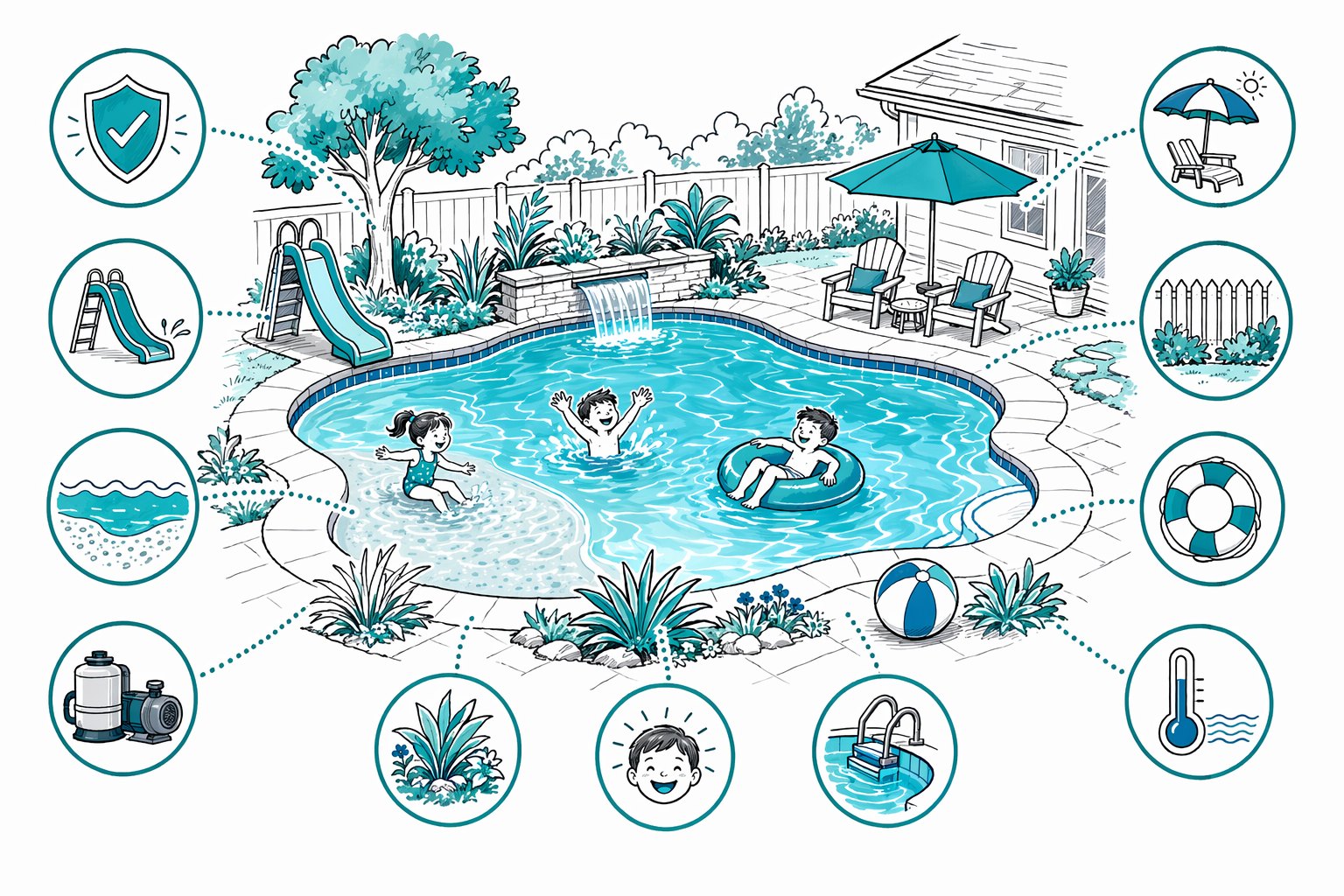
Start with how your family will really use the pool
Families often shop by photos first. That is normal. But with kids, the better starting point is how the pool will be used on a regular Tuesday, not just on a summer party day.
Think about:
- Ages now and ages later. A shallow play area may help with younger kids, but teenagers often want room to swim, play, and have friends over.
- Who will supervise. If adults will be watching from the kitchen, patio, or living room, your sight lines matter.
- How many swimmers at once. Two kids and one parent is a different layout than four kids plus cousins every weekend.
- How much deck space you need. Strollers, towels, toys, chairs, and shade structures take more room than people expect.
- Noise and traffic. Where will kids enter the yard? Will they run past steps, grills, or hard corners?
For many families, a simple shape works best. It usually gives more usable swim space, clearer sight lines, and easier cleaning. Fancy curves can look nice, but they can also create dead corners and less useful shallow area.
Pool type matters too. If you are still comparing options, see pool type comparison. In general, gunite/concrete gives the most design freedom, fiberglass can be quicker to install in the right site conditions, and vinyl-liner can lower upfront cost. The right fit depends on your yard, goals, and area, not just the lowest number.
Kid-friendly features that are worth discussing early
A family pool does not need every add-on. But a few choices can make daily use easier and safer.
1. Shallow entry and easy exit points
Wide steps, benches, and handholds help kids, grandparents, and guests. You want more than one easy way out of the water.
2. A clear shallow area
Many families like a generous shallow section for play. That can be more useful than a dramatic deep end if your kids are still young.
3. Slip-resistant deck surfaces
Wet concrete or smooth tile can be slick. Ask builders what deck finishes hold up well and reduce slipping.
4. Shade and seating
Heat is part of family pool use. A pool that looks good at 6 p.m. may be miserable at 2 p.m. without shade.
5. Lighting for visibility
If anyone will swim near sunset, lighting should help adults see the water clearly. It is not just for appearance.
6. Room for a compliant barrier
This is a big one. Leave space for fencing, gates, and safe access. Read pool safety barriers before you lock in a layout.
A common mistake is spending the budget on water features, then cutting practical items that families use every day. A waterfall is fun. But safe access, deck space, barrier planning, and a good equipment location usually matter more over time.
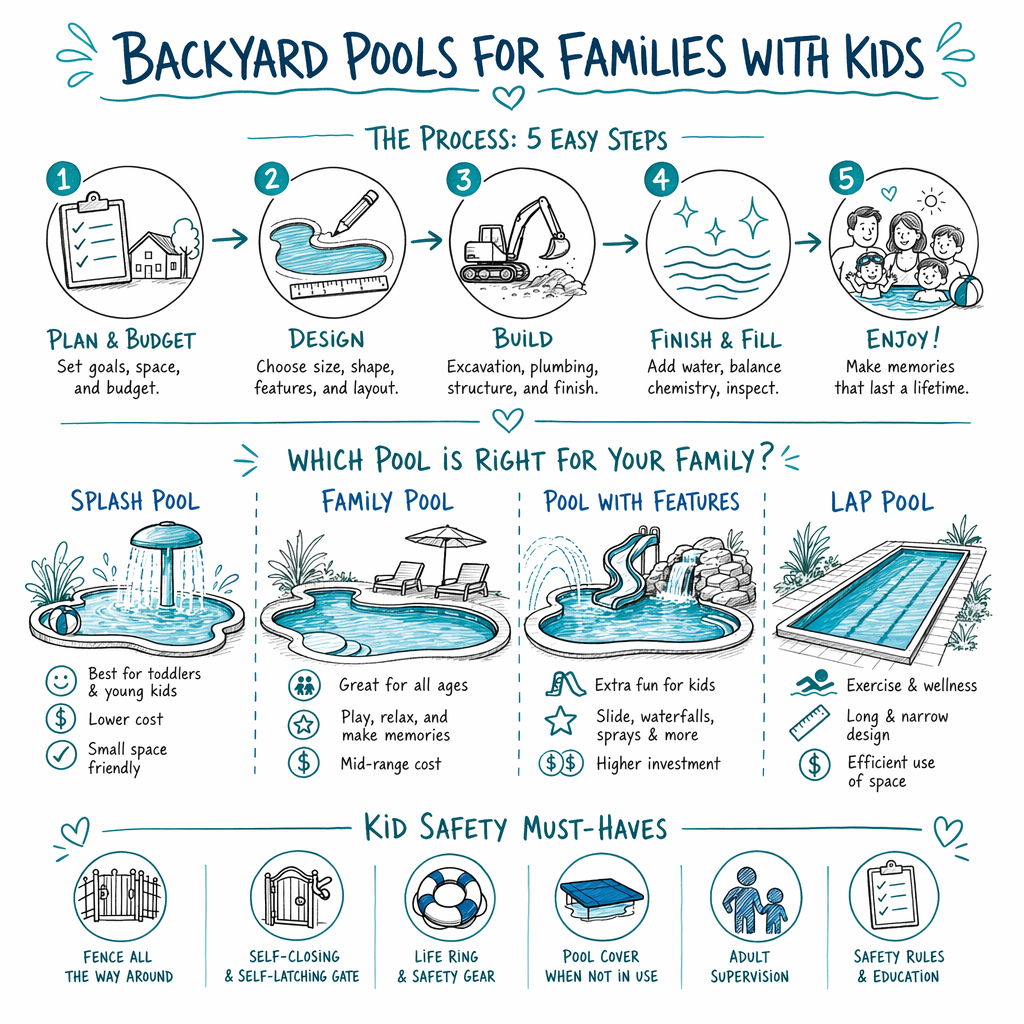
Honest cost ranges for family backyard pools
For a basic in-ground pool project in the US, typical starting ranges often look like this:
- Gunite/concrete: about $60,000-$135,000
- Fiberglass: about $45,000-$95,000
- Vinyl-liner: about $35,000-$70,000
- Smaller or plunge pools: often less, depending on size and features
These are typical ranges, not quotes or guarantees. Real price depends on the pool type, size, access to your yard, soil and slope, finishes, equipment, decking, and your local labor and permit costs. For a closer look, visit pool costs.
For families with kids, the total budget often grows because of items outside the shell itself:
- Fencing and self-closing gate requirements
- Extra decking for supervision and seating
- Safer entry features like wide steps or tanning ledges
- Heating, if you want a longer swim season
- Automatic covers or other safety-focused upgrades where allowed
- Landscape repair after construction
What surprises homeowners most is not always the pool. It is the site work and surrounding area. Tight yard access, retaining needs, drainage fixes, moving utilities, and upgrading the patio can move the final number fast.
That is why it helps to compare more than one written proposal. Look at scope, not just price. One builder may include permits, startup, basic decking, and cleanup. Another may leave those out. The lower number is not always the lower total.
Safety and legal basics you should not skip
DeepEnd Match is a free matching service, not a builder. We do not build pools or give legal, structural, electrical, or plumbing advice. But we can tell you where families get burned: they assume safety and permit details will just “get handled.”
Do these things before you sign:
- Hire only licensed, insured, and bonded builders where required, and verify the license, insurance, and bond yourself
- Get the price, payment schedule, materials, equipment, and scope in writing before any deposit
- Ask who is handling permits and inspections, then confirm what your city or county requires
- Learn your local rules for fencing, gates, alarms, and other pool-safety measures
- Hold final payment until the agreed work is completed
Permit and barrier rules vary by area. Start with pool permits explained if you are new to the process.
Also think beyond the build. Families should plan pool rules early: who can open the gate, where toys are stored, whether there is a phone nearby, and how adults rotate supervision. A pool is not safe because it is familiar. It is safer when the setup and routine are clear.
Your next step: compare builders the smart way
You do not need to become a pool expert before talking to builders. You do need a clear shortlist of questions.
Bring these to each conversation:
- What pool type fits my yard and family use best, and why?
- What is included in this price range, and what is not?
- What safety-barrier work is part of the project, if any?
- Who handles permits, inspections, and scheduling?
- What access issues or site problems could change the price?
- What warranty documents will I receive in writing?
Then compare apples to apples. Ask for the same basic pool size, finish level, and deck allowance from each builder if possible.
DeepEnd Match helps homeowners get matched, at no cost, with builders who say they are licensed, insured, and bonded. Participating builders pay a flat fee to be included. You compare quotes, you choose who to hire, and you hold the final payment.
If you are ready to start, use Get Matched. If you want help checking companies first, read how to vet a pool builder.
For a family pool, think about safety, shallow space, deck room, and fencing before looks. Compare written estimates from licensed, insured, bonded builders, verify credentials yourself, and use DeepEnd Match to get matched for free.
Common questions
What is the best in-ground pool type for families with kids?
There is no single best type for every family. Gunite/concrete offers the most design flexibility, fiberglass can be a good fit for some yards and timelines, and vinyl-liner can lower upfront cost. The right choice depends on your yard, budget, desired features, and local builder availability.
How deep should a family pool be?
That depends on your kids' ages and how you plan to use the pool. Many families get more day-to-day use from a larger shallow area than from a very deep end. If diving is a goal, discuss that clearly with licensed, insured, bonded builders and follow local codes and safety requirements.
How much should a family expect to spend on a backyard pool?
Typical US ranges are about $60,000-$135,000 for gunite/concrete, $45,000-$95,000 for fiberglass, and $35,000-$70,000 for vinyl-liner, with smaller or plunge pools often costing less. These are estimates, not quotes. Actual price depends on type, size, site, finishes, and area.
Can DeepEnd Match help me find a builder who speaks my language?
Yes. DeepEnd Match is a free multilingual matching service for US homeowners, including new immigrants and non-native English speakers. We can help you get matched with builders for your project, but you should still verify each builder's license, insurance, and bond yourself and get all scope and pricing in writing.