The short answer
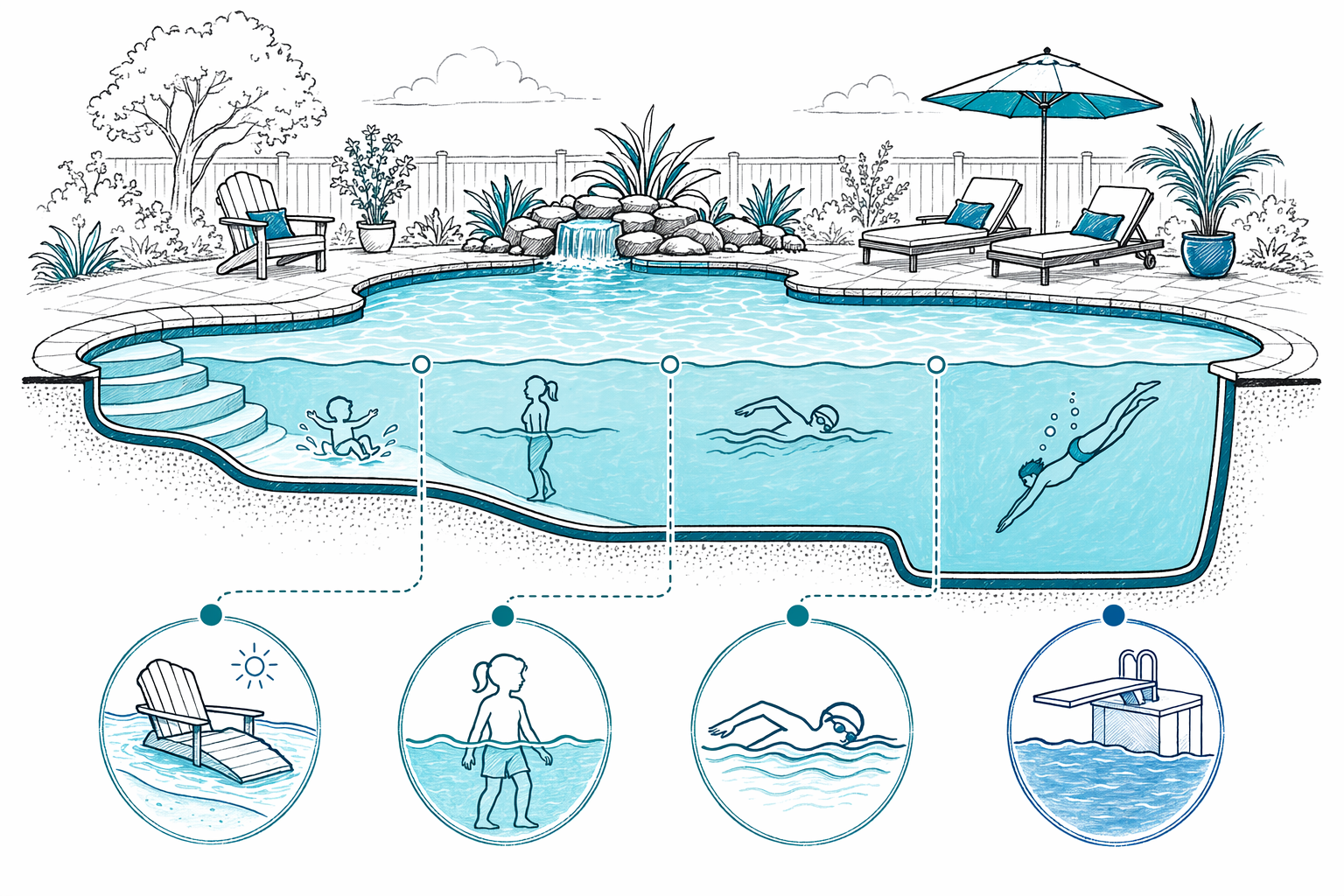
For many families, a play pool depth of about 3.5 to 5.5 feet works well. It gives kids and adults room to stand, move, and play without making the whole pool too deep.
A common layout is:
- Shallow end: 3 to 3.5 feet
- Middle: 4 to 5 feet
- Deep end: 5 to 6 feet
If you mainly want to relax, cool off, and let kids play, you may not need a deep end at all. A pool that is too deep can cost more to dig, build, fill, heat, clean, and fence.
If you want a plunge pool, exercise pool, or lap pool, the right depth changes. The best choice is usually the one that fits your real daily use, not the one that sounds impressive on paper. Before you talk to builders, it helps to compare pool types and layouts in pool type comparison.
Start with how you will use the pool
A good pool depth starts with honest answers. Ask yourself: What will happen in this pool on a normal Saturday?
1. Family play and hanging out
Most homeowners do best with a shallow-to-medium pool. Adults can stand in much of the pool. Kids have room to play. You also get more usable floor area.
2. Lounging and cooling off
If the goal is relaxing, tanning ledges, conversation, and easy entry, a shallower pool often makes more sense than a deep one.
3. Lap swimming or exercise
Many exercise pools do not need a very deep end. Consistent depth can work better than a dramatic slope.
4. Diving
Diving changes everything. It needs specific depth, length, slope, and safety planning. Do not assume a "deep pool" alone makes diving safe.
5. Volleyball, basketball, or teen play
Mid-depth pools are often more useful than very deep pools because more people can stand and move comfortably.
6. Small yard or plunge pool
Smaller pools are often kept shallower so the whole space stays usable.
Depth also affects the kind of pool you choose. Typical installed cost ranges vary by type. Real price depends on type, size, site, finishes, and area. Many homeowners start by comparing gunite/concrete pools with fiberglass pools or vinyl-liner options.
Typical depth ranges that make sense
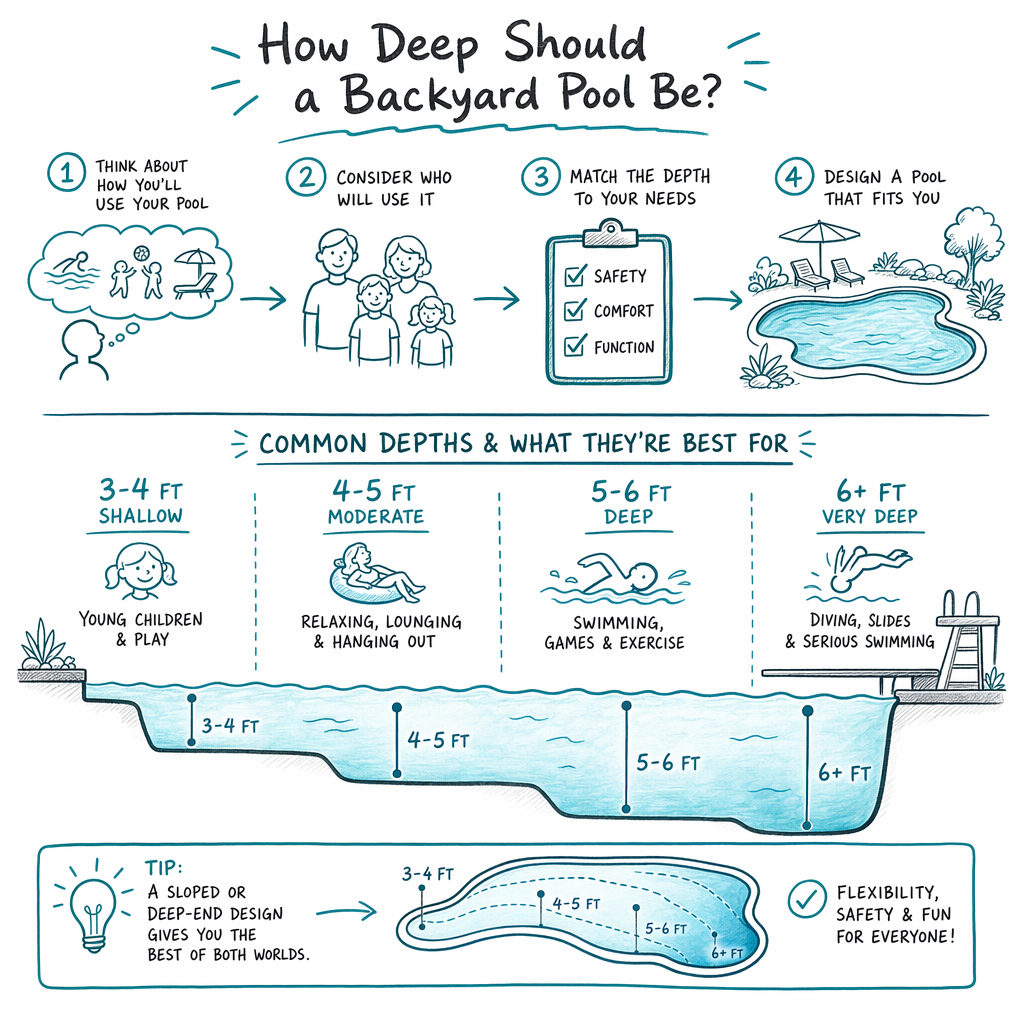
Here are typical depth ranges, not rules. The right plan depends on your family, yard, and goals.
- Kids' play / family pool: 3 to 5 feet in much of the pool
- General recreation pool: 3.5 to 5.5 feet
- Pool with a modest deep end: 3.5 to 6 feet
- Plunge pool / cocktail pool: about 4 to 5.5 feet, sometimes less
- Lap or exercise pool: often around 4 to 5 feet, sometimes uniform depth
- Diving pool: deeper and longer, with special shape and safety requirements
A few practical points homeowners often miss:
- More depth is not always more useful. In many backyards, a 7- or 8-foot deep end gives you less standing room and fewer people actually use it.
- The floor slope matters. A steep drop can reduce usable play space.
- Entry style matters too. Tanning ledges, wide steps, and benches take space, which affects where depth changes should happen.
- Your climate matters. In colder areas, extra water volume can mean higher heating costs.
Typical pool cost ranges in the US are often around:
- Gunite/concrete: $60,000 to $135,000+
- Fiberglass: $45,000 to $95,000+
- Vinyl-liner: $35,000 to $70,000+
- Smaller plunge pools: often less, depending on size and features
These are estimates, not quotes. The real price depends on pool type, size, site access, soil, finishes, equipment, and your local area. A deeper pool can increase excavation, structural needs, water volume, decking changes, and operating costs. If you want a fuller breakdown, see pool costs.
When deeper makes sense, and when it usually does not
Sometimes a deeper pool is the right call. Often, it is not.
Deeper may make sense if:
- You have older kids or strong swimmers who will actually use a deeper end
- You want a true diving setup and local code allows it
- You want the look and feel of a classic deep-end pool
- Your design includes a use that really needs more depth
Deeper often does not make sense if:
- Most users are young children, guests, or casual swimmers
- You want water games where people stand
- Your yard is small and every foot of usable space matters
- You want to control construction and heating costs
- You prefer easier cleaning and simpler maintenance
One common homeowner regret is this: they pay for depth they rarely use. Another is making the shallow end too shallow or too short, so adults cannot comfortably stand or kids quickly outgrow it.
If you are thinking about a diving board or slide, be extra careful. These features involve serious safety and code issues. Rules vary by area and by the specific pool shape and dimensions. Always use a licensed, insured, and bonded builder, verify the license, insurance, and bond yourself, and follow local permit and pool-safety barrier laws. Review pool safety barriers before you decide on a layout.
What to do before you talk to builders
You do not need perfect answers before you start. But a short plan helps you get better bids and avoid expensive changes later.
1. List the top 2 uses
Write down the two things your family will do most. Example: "kid play" and "adult relaxing," or "lap swimming" and "small parties."
2. Write your must-have standing depth
Think about the adults who will use the pool. Do you want to stand comfortably in part of it? In most of it?
3. Decide if you truly need a deep end
Be honest. If nobody will dive and most use is casual, you may not need one.
4. Measure the yard and note access
Tight access, slopes, utility lines, and small lots can affect what depth and shape are practical.
5. Ask each builder the same questions
Get the proposed depth profile, overall dimensions, safety features, equipment, and scope in writing before any deposit.
6. Verify credentials yourself
Hire only licensed, insured, and bonded builders. Verify all three yourself. Also ask who handles permits and inspections, and make sure local rules are followed. A good starting point is how to vet a pool builder.
DeepEnd Match is a free matching service. We help you compare licensed, insured, bonded pool builders so you can compare options and choose who to hire. If you are ready, start here: Get matched.
For most backyards, a pool around 3.5 to 5.5 feet deep is more useful than a very deep pool. Think about how your family will really use it, compare written bids from licensed, insured, bonded builders, verify credentials yourself, and choose the depth that fits your yard, safety needs, and budget.
Common questions
What is the most practical depth for a family pool?
For many families, about 3.5 to 5.5 feet is the most practical range. It gives you more usable space for standing, playing, and relaxing. The best depth still depends on who will use the pool most, the pool size, and whether you want a deep end at all.
Does a deeper pool cost more?
Usually yes. A deeper pool can mean more excavation, more materials, more water, and higher heating and maintenance costs. These are typical patterns, not guarantees. Real price depends on type, size, site, finishes, equipment, and area.
Do I need a deep end for diving?
Not automatically. Diving needs the right depth, shape, slope, and length, plus compliance with local codes and safety requirements. Never assume a general deep end is enough. Use a licensed, insured, and bonded builder, verify those credentials yourself, and make sure the design follows local permit and pool-safety rules.
Is a flat-bottom pool better than a pool with a deep end?
Sometimes. A flatter or more uniform depth can be better for games, exercise, lounging, and easier use of the whole pool. A pool with a deep end may suit certain preferences or activities, but many homeowners find they use the shallow and mid-depth areas much more often.