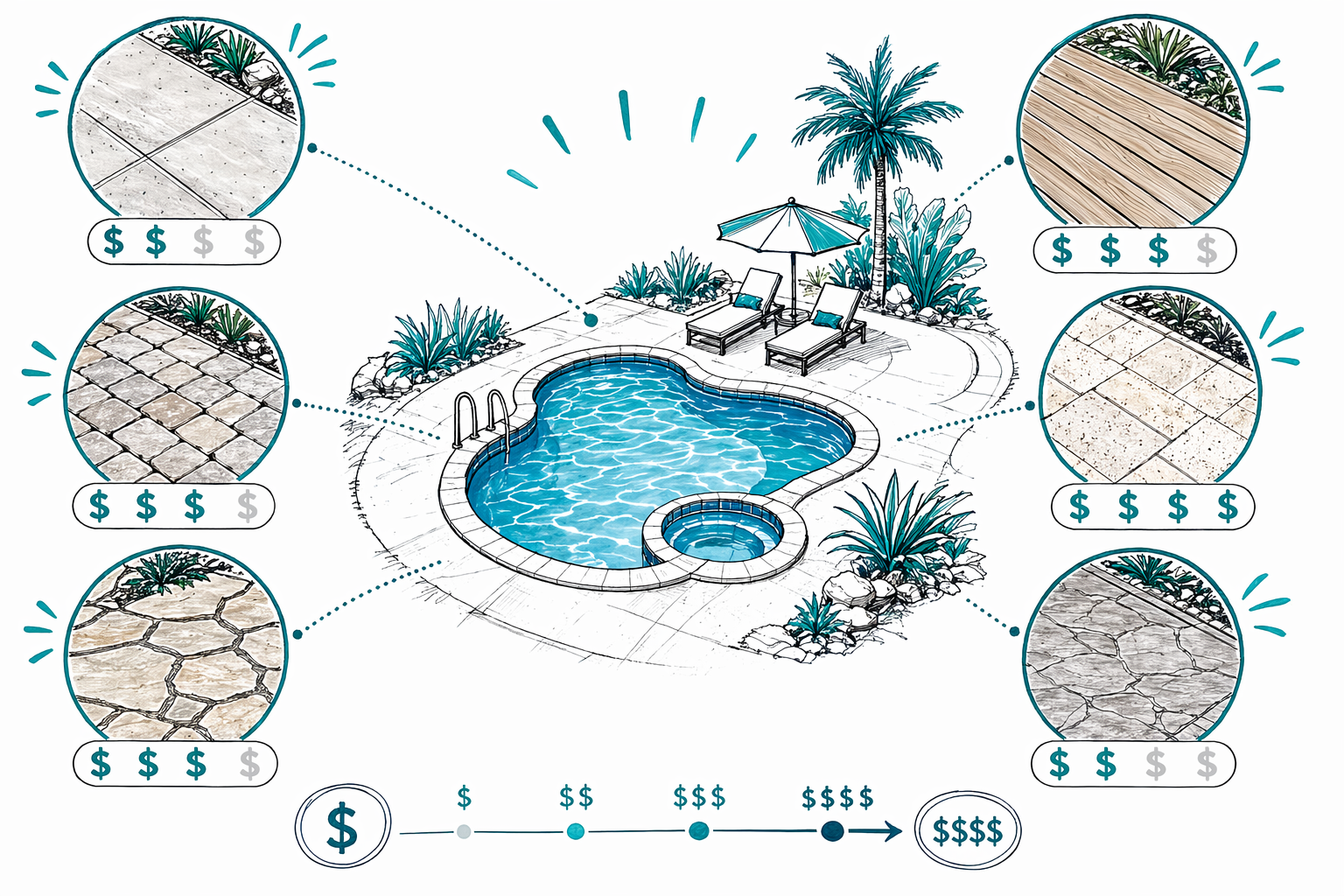
The short answer: what pool decks usually cost
A pool deck is the hard surface around the pool. It gives you space to walk, place chairs, and move safely in and out of the water. For many homeowners, the deck becomes a big part of the total project cost.
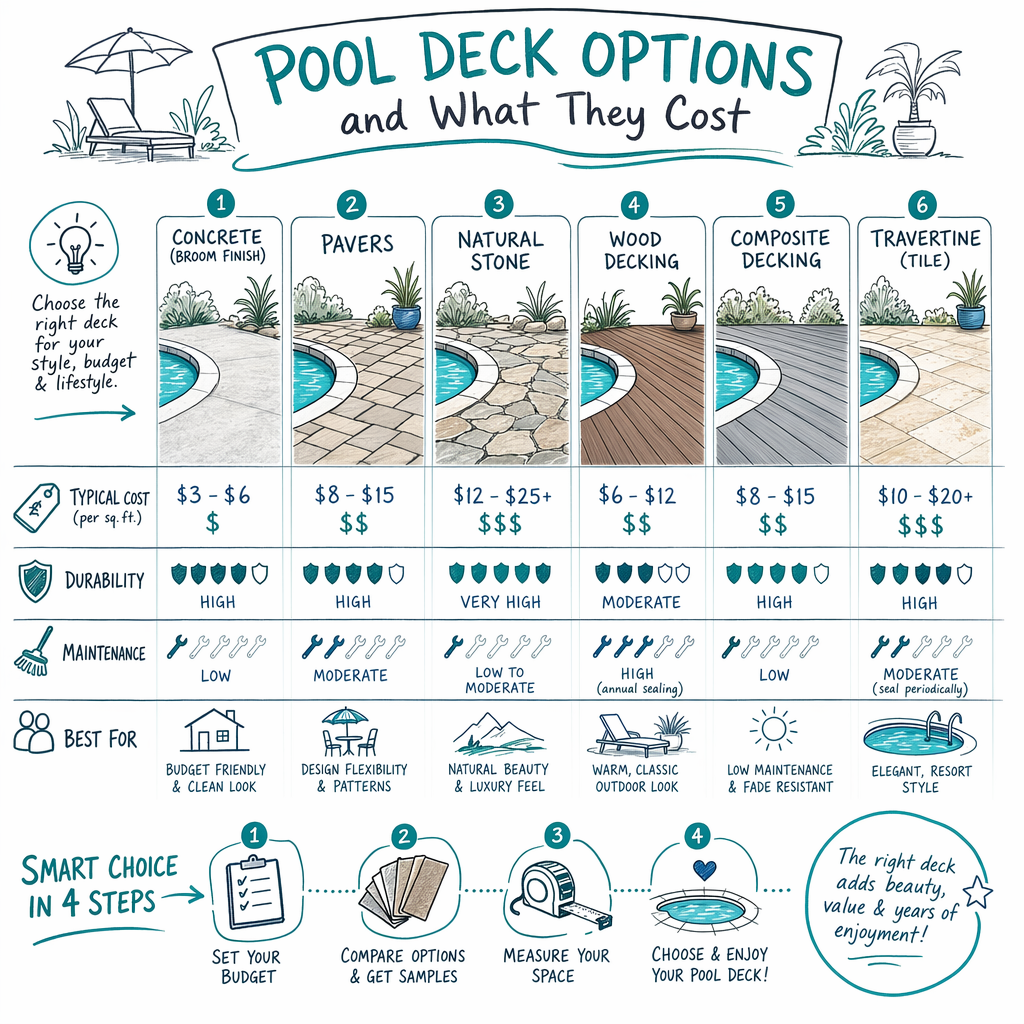
Typical installed deck costs often fall in these ranges:
- Broom-finish concrete: about $8 to $16 per square foot
- Stamped or colored concrete: about $12 to $25 per square foot
- Pavers: about $15 to $35 per square foot
- Natural stone: about $20 to $45+ per square foot
- Travertine: about $20 to $40 per square foot
- Wood decking: about $15 to $35 per square foot
- Composite decking: about $20 to $45 per square foot
Those are typical ranges, not quotes. Real price depends on deck size, shape, grading, drainage, soil, demolition, finish level, and local labor costs.
For a simple example, a modest deck area of 600 square feet could be around:
- Concrete: $4,800 to $9,600
- Stamped concrete: $7,200 to $15,000
- Pavers: $9,000 to $21,000
- Travertine or stone: $12,000 to $27,000+
If you are still comparing full pool types and budgets, see pool type comparison and general costs.
How to choose the right deck material
The cheapest deck is not always the best value. A smart choice depends on heat, slip resistance, maintenance, repair cost, and appearance.
Here is how common options compare.
Concrete
Concrete is common because it is usually the lowest-cost hardscape option for in-ground pools. It can be plain broom-finish, colored, exposed aggregate, or stamped to look like stone.
- Best for: budget control and clean, simple layouts
- Pros: lower upfront cost, many finish choices, easy to shape around curves
- Cons: can crack over time, some finishes get hot in strong sun, stamped surfaces may need resealing
Pavers
Pavers are individual units set on a prepared base. Many homeowners like them because they look upscale and damaged sections can be repaired without tearing out the whole deck.
- Best for: long-term flexibility and higher-end appearance
- Pros: strong visual appeal, easier spot repairs, many colors and patterns
- Cons: higher upfront cost, weeds or settling can happen if base work is poor
Travertine and natural stone
Travertine is popular around pools because it often stays cooler under bare feet than darker concrete. Natural stone can look beautiful, but material and labor costs are higher.
- Best for: premium look and cooler walking surface
- Pros: attractive, often cooler to the touch, can add resale appeal
- Cons: higher material cost, sealing may be needed, some stones are more porous or slippery when polished
Wood or composite decking
These are less common directly around in-ground pools than concrete or pavers, but they can make sense in some designs, especially with raised pools, sloped yards, or a modern look.
- Best for: certain layouts where a framed deck works better than masonry
- Pros: warm look, useful on difficult sites, composite needs less maintenance than wood
- Cons: can cost more than basic concrete, wood needs ongoing care, some products get hot or slippery
Whatever material you choose, ask each builder about surface temperature, slip resistance, drainage slope, expansion joints, and repair process. Those details matter as much as color and pattern.
What makes deck pricing go up
Two pool decks made from the same material can have very different prices. That is why homeowners get confused when one estimate seems much lower.
The biggest price drivers are usually:
1. Deck size
More square footage means more material, labor, base prep, and edge work.
2. Site prep and demolition
Removing old concrete, tree roots, poor soil, or uneven grading adds cost.
3. Drainage work
A good deck should move water away from the pool and away from your house. Drains, grading, and extra base work can raise the price, but they help prevent bigger problems later.
4. Shape and detail
Curves, steps, seat walls, planters, coping details, and custom inlays take more labor.
5. Finish level
Basic broom-finish concrete costs less than stamped, colored, saw-cut, or decorative finishes.
6. Access to the yard
Tight access can mean more hand labor, smaller equipment, or extra hauling.
7. Regional labor and material costs
Prices vary a lot by state, city, and season.
A low number on paper can also hide missing items. Ask for price and scope in writing before any deposit. Make sure the written scope says:
- total deck square footage
- exact material and finish
- thickness or base prep details where relevant
- drainage work included or not
- coping included or not
- sealing included or not
- cleanup and haul-away included or not
- change-order process
This is also a good time to review how to vet a pool builder. Hire licensed, insured, and bonded builders, and verify the license, insurance, and bond yourself.
Common mistakes that cost homeowners money
People usually do not regret spending a little more on the right deck. They regret choosing a deck that looks good in a photo but does not work for their yard or climate.
Watch for these common mistakes:
- Choosing by color only. A dark surface may look sharp, but it can get very hot in summer.
- Ignoring slip resistance. Smooth finishes can be risky when wet.
- Skipping drainage questions. Water should not run back to the pool shell, house, or patio doors.
- Underbuilding the deck size. A deck can feel crowded fast once you add chairs, walking space, and equipment access.
- Not asking about repairs. Cracked concrete, shifting pavers, and stained stone all have different repair paths and costs.
- Forgetting maintenance. Some decks need resealing or more regular cleaning than others.
- Missing permit or code issues. Deck layout can interact with required fencing, gates, and safety barriers.
Pool areas also need to follow local rules for barriers and access. Read pool safety barriers so you know what questions to ask. And follow local permits and pool-safety laws.
If your project includes a new in-ground pool, keep the whole budget in mind. Typical pool ranges often start around $35,000 to $70,000 for vinyl-liner, $45,000 to $95,000 for fiberglass, and $60,000 to $135,000 for gunite/concrete, with smaller plunge pools sometimes costing less. Those are typical estimates only. Actual price depends on type, size, site, finishes, and area.
What to do next
You do not need to know the perfect deck material before you start. You just need enough information to compare builders clearly.
A simple next-step plan:
- Pick your top 2 or 3 deck materials. Think about heat, maintenance, look, and budget.
- Decide how much deck space you really want. Include room for walking, lounge chairs, and outdoor dining if that matters to you.
- Ask each builder the same questions. Surface temperature, slip resistance, drainage plan, repair process, and warranty terms.
- Get scope and price in writing before any deposit. Compare what is included, not just the total number.
- Verify credentials yourself. Confirm the builder is licensed, insured, and bonded.
- Hold final payment until the job is complete according to the written scope and any required local inspections.
DeepEnd Match is a free matching service for homeowners. We do not build pools or decks. We help you connect with builders so you can compare quotes, you choose who to hire, and you hold the final payment. If you want to start talking to local pros, use get matched.
Pick a deck by more than looks. Compare concrete, pavers, and stone for heat, slip resistance, maintenance, and repair cost. Get the material, square footage, drainage, and total scope in writing. Hire licensed, insured, and bonded builders, verify that yourself, and compare more than one estimate before you choose.
Common questions
How much deck do I need around a pool?
It depends on how you will use the space. A narrow walking border costs less, but many homeowners wish they had planned more room for chairs, dining, or safe traffic flow. Builders often price by square foot, so even a modest increase in deck size can change the total. Ask for a layout that shows clear walking space, furniture area, and access to equipment.
What pool deck stays coolest in the sun?
Lighter colors usually stay cooler than darker ones. Travertine is often chosen because it can feel cooler under bare feet than some concrete or darker stone. But no surface stays cool in every climate. Ask each builder about the exact material and color you are considering, not just the category.
Is stamped concrete better than pavers?
Not always. Stamped concrete often costs less upfront and can look good, but it may crack over time and repairs can be more visible. Pavers usually cost more at the start, but individual pieces can be repaired or reset more easily if settling happens. The better choice depends on your budget, soil conditions, design, and how long you plan to stay in the home.
Do I need a permit for the pool deck?
Sometimes, yes. Permit rules vary by city and county, and deck work can connect to grading, drainage, setbacks, and pool barrier rules. Ask your builder what local permits may apply, and verify with your local building department. Always follow local permits and pool-safety and fencing laws.